Address the ongoing facility as part of the handover.
Section 83 concerns the decommissioning of a facility or part of it. For a hotel facility that will remain in operation, see the article on hotel succession.
unternehmensnachfolge-anwalt.at
Mag. Bernhard Brandauer, Rechtsanwalt
Section 83 GewO requires prior notice, safeguards and a formal authority finding when an operating facility or part of it is decommissioned.
A business succession may involve closing one part of an operating facility while the rest of the business continues. Section 83 of the Austrian Trade Regulation Act (Gewerbeordnung 1994, GewO) addresses the intended decommissioning of an installation within the meaning of section 74(2), in whole or in part. It sets out safeguards and notification steps for that situation.
The holder of the facility must take the necessary safeguards and notify the competent permitting authority of the start and planned measures in advance. An authority's order remains effective despite a change in the identity of the holder. The decommissioning is legally complete only when the final authority decision has become final.
This check follows the sequence in section 83 GewO. Review the actual permit file and authority decisions for your situation.
Already know you want to get in touch? Go straight to the enquiry form.
A change in management and the decommissioning of a facility are different events.
Section 83 concerns the decommissioning of a facility or part of it. For a hotel facility that will remain in operation, see the article on hotel succession.
Notify the competent authority of the start and planned safeguards before work begins. Section 83 sets no general number of days. If decommissioning has already started, have the procedural position assessed promptly.
Section 83(4) leaves the effect of an order under subsection 3 unchanged despite a change in the identity of the holder who is decommissioning the facility. Record the order, its addressee, outstanding measures and supporting evidence for the handover.
After completing the safeguards, notify the permitting authority. The completion notice alone does not replace the authority's final determination.
Gather the permit, advance notices, orders and records showing which measures were completed. The complete file is needed to identify any remaining safeguards.
Section 83 is triggered by the intended decommissioning of a facility within the meaning of section 74(2) GewO, either in full or in part. A change of shareholders or management alone does not describe that event. The succession review should identify which technical facility or part is actually going to be closed.
Use the permit, facility description and planned work to define the affected area. A commercial division of the company is not automatically the same thing as part of an operating facility. If the facility will continue to operate, the hotel succession article addresses issues around ongoing operation. A contractual duty to continue the business after a transfer is a separate issue. The article on the duty to continue a business after transfer discusses the scope and consequences of that duty.
The current wording of section 83 GewO 1994 in the RIS sets out the scope and sequence of the procedure. Other rules on transferring permits remain outside this article.
Under section 83(1), the holder must take the necessary safeguards so that the decommissioned facility or part of it no longer causes danger, nuisance, impairment or another adverse effect covered by section 74(2). The measures depend on the facility, its location and how decommissioning is planned.
A practical review may consider equipment and substances left on site, machinery, pipes, storage areas and access controls. The condition of the facility and the interests protected by section 74(2) determine which measures are needed. A handover file should record the steps taken and how their completion can be checked. This is a practical record, not an additional statutory checklist.
The safeguards address effects arising from the facility during and after decommissioning. Transferring the facility or changing the contracting party does not answer whether the required protective measures have been completed.
Before decommissioning begins, the holder must notify the authority responsible for the facility approval of the start and the safeguards planned for the work. Section 83(2) sets the timing as prior to the start; it does not prescribe a general number of days.
For a reliable record, a written notice can identify the site, the affected area, the intended start and the proposed safeguards. Existing plans and a short explanation can help the authority assess the proposal. Those supporting documents are a practical aid. The statutory requirement is advance notice of the start and planned safeguards.
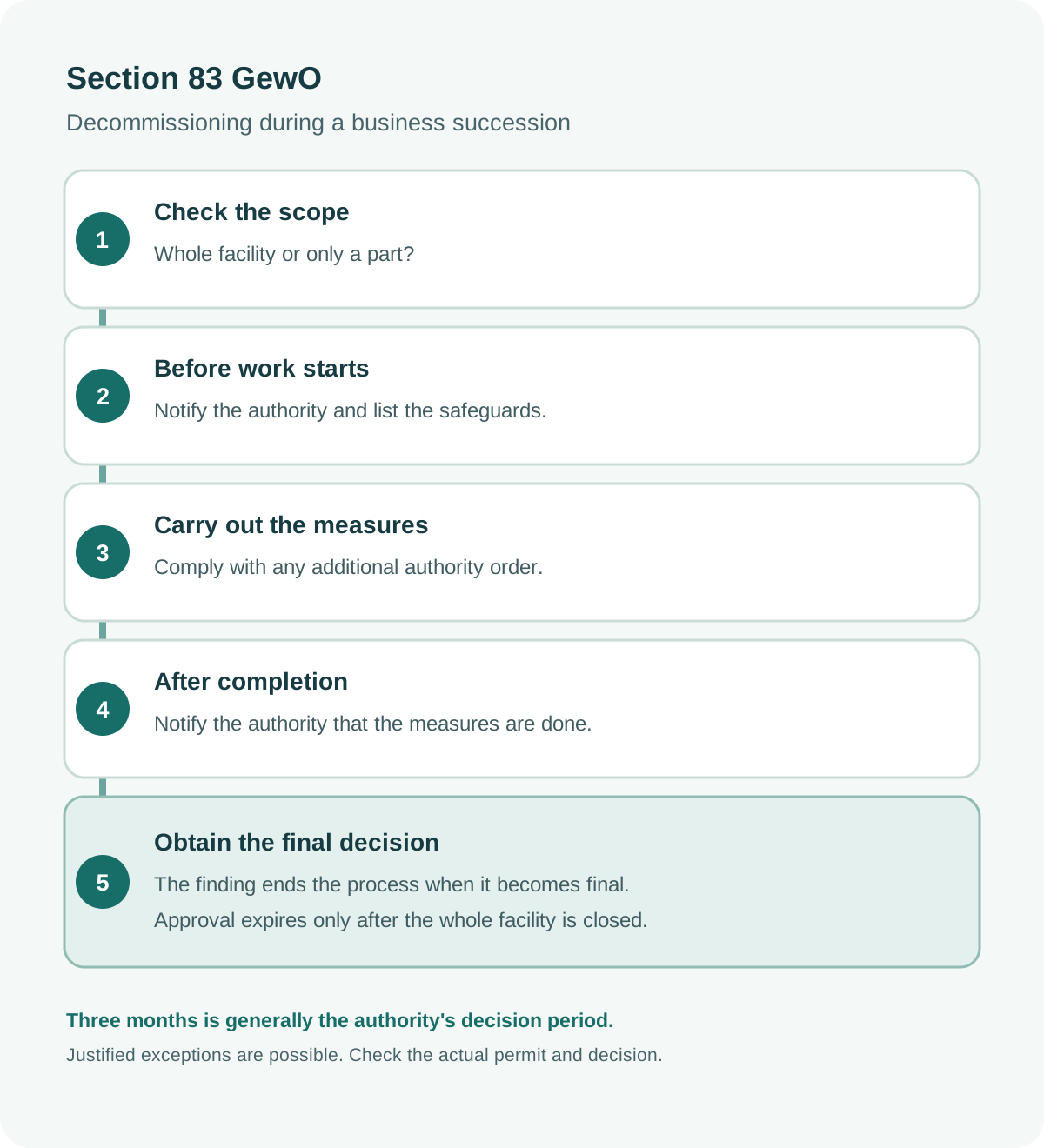
Infographic: the sequence under section 83 GewO. The three-month period concerns the permitting authority and allows justified exceptions.
If the notified safeguards are insufficient to protect the interests under section 74(2), or necessary measures have not been taken or have only been partly completed, the permitting authority must order the required measures by formal decision. That decision specifies what must be done in the particular case.
Section 83(4) states that a change in the identity of the holder who is decommissioning the facility does not affect the validity of the order under subsection 3. The succession therefore does not make an existing order ineffective. This provision addresses the effect of the authority's order. It does not allocate costs between the transferor and successor under their private agreement.
Keep the complete decision with the handover records, including its addressee, required work and evidence of completion. This allows the incoming management to see which authority measures are still outstanding.
Once the notified or ordered safeguards have been completed, the holder reports this to the permitting authority. If the measures are sufficient and no further order under subsection 3 is required, the authority must confirm that finding in a formal decision.
The authority generally has three months to issue that decision after the notice under subsection 2 or after issuing an order under subsection 3. The Act allows justified exceptions. This is the authority's decision period, not a general deadline by which the holder must complete decommissioning.
Decommissioning is complete when the finding becomes final. For complete decommissioning, the facility approval then expires. Section 83(6) does not provide for that expiry where only part of the facility is decommissioned. Keep the advance notice, orders, evidence of completed measures, completion notice and final decision together in the handover file.
Section 83 concerns the intended decommissioning of a facility or part of it. A change of owner or shareholders alone is not that event. Separate rules may apply to other changes.
The start of decommissioning and the safeguards planned for it must be notified to the competent permitting authority in advance. Section 83 sets no general number of days.
No. Under section 83(4), a change in the identity of the holder does not affect the validity of an order issued under subsection 3.
It generally applies to the permitting authority issuing the final decision. Justified exceptions remain possible.
Section 83(6) provides for expiry after complete decommissioning of the facility. It does not assign that consequence to decommissioning only part of it.
Book an initial consultation. We clarify the legal framework, critical documents and next steps. Callback within one working day.
Contact us